Dental cleanings stir up extra mythology than they are entitled to. I hear versions of the very same problems weekly: cleanings hurt, they scrape away enamel, whitening is part of a cleansing, flossing prior to your go to conceals the reality, and the twist, if absolutely nothing harms you can skip a visit. These concepts maintain individuals away until a small issue comes to be an urgent one. A great cleaning is calm, methodical, and concentrated on prevention. It lasts under an hour in many cases and leaves you with fewer troubles down the road.
I have dealt with individuals who avoided the chair for years because of one harsh experience, just to discover that techniques and tools have altered a great deal since that memory. A lot more vital, a thoughtful hygienist readjusts the approach to your mouth, not vice versa. Pain is not an inescapable conclusion. Allow's different reality from fiction and walk through what in fact occurs, start to complete, and why it matters despite your age, dental implant condition, or sensitivity.
What a cleansing truly is
An oral cleansing is preventative therapy. The objective is to eliminate soft plaque and solidified tartar, interrupt bacterial nests below the gumline, and polish surfaces so new plaque has a more difficult time sticking. The appointment also screens for dental cancer cells, cavities, periodontal condition, cracked dental fillings, and modifications in bite or jaw feature. It is much less concerning making teeth look glossy and extra concerning keeping the entire dental system stable.
Plaque integrates in hours, tartar in days. As soon as plaque mineralizes on the tooth, cleaning does not eliminate it. Think of tartar like barnacles on a boat hull, small in the beginning, then layered and stubborn. Left in position, it maintains the gums irritated, and inflamed gum tissues open the door for bacteria to access the sustaining ligaments and bone. That is how gum condition begins, and it advances silently in lots of people. The hygienist's job disrupts that cycle at a phase when everything is still reversible.
Myth 1: Cleanings hurt by default
Pain is not the price of admission. Experience depends upon the health of your gum tissues, the quantity of accumulation, your general discomfort threshold, and the strategy your medical professional makes use of. In a mouth with modest tartar and moderate inflammation, the majority of clients define the sensation as stress and scuffing, not discomfort. If you have locations of recession, subjected origin surfaces can be sensitive to temperature and touch. That is manageable.
Modern hygiene sees use a number of tools to reduce irritation. Ultrasonic scalers vibrate at high regularity to chip away tartar while purging the area with water. The suggestions are slim and enable a gentle approach along the gumline. Hand instruments fine-tune sides where required. Topical numbing gel can assist in localized spots, and for clients who really feel nervous or have generalized level of sensitivity, light regional anesthesia or laughing gas makes the see comfortable. If a medical professional senses you are tensing up, they can decrease and alter strategies. A professional center, whether a general Dental expert or Aesthetic dentist setup, values convenience as part of clinical quality. If you are searching for a dental expert near me and convenience is high on your list, inquire about these options before you book.
Myth 2: Scuffing problems enamel
I hear this a great deal, especially from adults that really feel the gritty drag of a scaler and presume tooth is being cut away. Enamel is more challenging than steel on the Mohs range. Instruments scrape calculus, not enamel. The audio and resonance make it appear much more significant than it is. An experienced hygienist angles the pointer to involve the side of tartar so it exfoliates, leaving the surface intact. If you have actually bound https://dental-implants-periodontistamkb496.iamarrows.com/why-oral-layouts-boston-is-changing-the-method-you-consider-smiles fillings, veneers, or a dental implant crown, the clinician alters the tool and pressure to secure those surfaces.
Where caution issues gets on exposed origin surface areas. Cementum and dentin are softer than enamel. Aggressive method below could produce a notch with time, which is why strategy and training are important. In a well-run oral facility, you will certainly see hand instruments in great problem and suggestions created for specific jobs. It is another factor to prevent jumping between discount cleansings that hurry the process. Regular care at a method that values instrumentation and proceeding education goes a lengthy way.
Myth 3: Bleaching becomes part of a cleaning
Polishing gets rid of tarnish, not color. That coffee tint that vanishes after a prophy paste is not long-term tooth color, it is surface area stain. Whitening adjustments inherent color with peroxide, either in-office or with custom-made trays in your home. If your goal is a brighter smile, request a color assessment and strategy around upcoming occasions. A Cosmetic dental professional can match whitening with repairs like composite bonding for chips or gaps. The cleansing establishes the stage because a clean surface accepts lightening extra evenly, however both are different services.
Myth 4: If I brush and floss, I can miss cleanings
Home treatment and specialist treatment enhance each other. Also exceptional brushers miss out on some locations regularly. Many people have a leading hand pattern that favors one side. Crowded reduced front teeth, the rear of molars, and the gumline around old remediations prevail trap zones. Over 6 months, small misses out on add up. A cleaning resets the baseline so your everyday practices work as intended.
The other factor not to skip check outs is diagnostic. Early dental caries and early gum tissue illness are typically painless. I have seen patients with no problems who, on examination, had deep pockets behind their lower molars or decay under an aging crown. Caught very early, these issues are uncomplicated. Wait enough time and you are discussing emergency situation oral services, root canals, removals, or even oral implants with a periodontist. Preventative treatment is not a guarantee against troubles, yet it transforms the odds and the cost.
Myth 5: Bleeding gums indicate the hygienist was also rough
Healthy gums do not hemorrhage when brushed, flossed, or gently probed. Bleeding is the hallmark of inflammation. If your gums hemorrhage throughout the cleaning, that is comments regarding the cells, not the clinician's perspective. The hygienist may explain areas that need a different flossing angle or a modification in brush head dimension. After an extensive cleaning and a week or 2 of constant home treatment, many people discover bleeding declines to near absolutely no. If it does not, that causes a more detailed search for systemic contributors like diabetes, smoking cigarettes, or certain medications.
Myth 6: Flossing right prior to the visit will trick the dentist
We can tell. Tissue informs the tale. Gum tissues that have been ignored for months look puffy and hemorrhage easily. Floss marks from the evening before do not simulate the tone and texture of regularly boosted periodontals. More important, you do not need to excite us. The factor is to partner on a strategy that fits your regimen. If floss is a battle, water flossers and interdental brushes are fair choices. Excellent hygienists show strategy in your mouth, not on a version, so you feel what "appropriate" feels like in the rooms you really have.
Myth 7: Cleanings loosen up teeth
Teeth do not come to be loosened since tartar is eliminated. When calculus builds under the gum tissue, it takes up room like a wedge. After it comes off, gum tissues can shrink to their regular placement, which can disclose movement that was concealed by swollen tissue. That flexibility already existed and suggests accessory loss from persistent swelling. The cleaning allows the area to recover and tighten in time. In innovative cases, a referral to a periodontist might be ideal for scaling and root planing or surgical therapy. If a tooth remains mobile, splinting or restorative work may protect it while recovery occurs.
Myth 8: Children do not require professional cleanings
Kids are not immune to plaque and tartar. Their diet, cleaning skill, and orthodontic home appliances influence danger. A quick polish and fluoride varnish every six months establishes solid habits and minimizes early decay. For kids in braces, I often recommend much more constant sees since braces develop plaque catches. The see is likewise a possibility to capture respiratory tract concerns, mouth breathing, and tongue stance problems that affect oral crowding and rest. A pediatric-friendly dental expert near me providing will commonly keep in mind habits assistance and desensitization methods if your youngster feels anxious.
What in fact happens at a cleaning, step by step
A conventional visit adheres to a sequence, with space to personalize. You sign in, review case history, and update medications. Lots of blood pressure medications and antidepressants influence saliva flow, which transforms decay threat. The hygienist checks out the graph with those factors in mind.
- Exam and testing: A quick dental cancer screening checks the tongue, flooring of mouth, cheeks, and taste. The hygienist notes any type of ulcers, white patches, or crookedness. If you have not had radiographs in a year or more, bitewings are required to check out bone degree and search for tooth cavities in between teeth. Low-dose electronic sensing units make this fast. In Boston, lots of practices, including Oral Designs Boston, make use of rectangular collimation to trim scatter radiation even further. Plaque and tartar elimination: Ultrasonic scaling loosens deposits with marginal stress. Water watering purges particles. Hand scalers refine margins and reach slim pockets. Sensitive areas get topical gel initially. If you have oral implants, the clinician changes to implant-safe ideas and plastic hand tools. The goal is thoroughness without trauma. Polishing and tarnish management: A rubber cup with a fine paste gloss enamel. For heavy discolor from tea, coffee, or red wine, air brightening with glycine powder can be gentler and a lot more efficient than abrasive paste. It is safe around a lot of reconstructions and, with calibration, around implants as well. Flossing and interdental cleansing: Last come on between teeth check for harsh edges or catching factors. If floss tears in one area, the hygienist looks for chipped fillings or looming margins that can catch plaque. Fluoride or desensitizer: Grownups with origin exposure, frequent snacking, or reduced saliva take advantage of a fluoride varnish. Individuals with new composite dental fillings or bleaching level of sensitivity occasionally choose a desensitizing agent instead. The option depends upon risk, not age alone. Personalized training: This is where a few targeted adjustments outmatch generic suggestions. You may require a smaller brush head, a various bristle pattern, or a water flosser timed for evenings. If you have joint inflammation or limited mastery, electric brushes deserve it. A hygienist who has cleaned up hundreds of mouths can match devices to routines in minutes.
Cleanings with special circumstances
Mouths are not one-size-fits-all. A thoughtful method accounts for tools, products, and clinical history.
Dental implants: Implants do not get dental caries, but the surrounding cells can establish peri-implant mucositis or peri-implantitis if plaque continues to be. We prevent metal scalers on implant abutments and crowns, utilize low-abrasion brightening powders, and focus on home care strategies under the prosthesis. An oral implants periodontist might join treatment if pockets grow or bone adjustments on radiographs. If you notice hemorrhaging around a dental implant, do not wait for your following recall visit. Call your dental clinic and request analysis. Early intervention is crucial here.
Orthodontic home appliances: Dealt with braces capture plaque at the brackets and under the cord. Air polishing minimizes chair time for heavy discolor. People that finish orthodontics with their periodontals healthy usually had 3 or four cleansings annually, not 2. Clear aligners can trap sweet liquids versus enamel. I ask aligner people to wash and wait a couple of minutes before re-seating trays after pleasant drinks.
Crowns, bridges, and veneers: Overhangs and open margins invite plaque. Threaders, soft choices, and water flossers make a distinction. We check for microleakage with an explorer and cool air. If you taste bitterness or notification dark lines at the gum tissue, state it. Small repair services beat big replacements.
Medical problems: Diabetes, maternity, Sjögren's disorder, GERD, and medicines that dry the mouth raising threat. A holistic dental professional Boston clients respect will consider your entire wellness context, not just your teeth. That might consist of saliva alternatives, xylitol lozenges, pH administration, and diet regimen timing, not just more brushing.
How commonly ought to you go
Six months is a common interval due to the fact that it helps lots of people and insurance embraced it decades earlier. It is not a legislation. Some mouths need three or four check outs annually, especially if you have a background of periodontal disease, smoke, put on braces, or have low saliva. Others, after years of steady measurements, succeed at nine to twelve months. Regularity is a clinical choice you make with your hygienist and dental practitioner, not an advantage routine determined by an insurance coverage pamphlet. If a method insists every person fits the exact same interval, ask why.
What to do if you have oral anxiety
Anxiety prevails, and it spans a variety. Some individuals just require extra explanation and a time out switch signal. Others gain from laughing gas, a comfort playlist, or desensitization over two brief brows through rather than one long session. A few requirement dental sedation suggested in advance. The best setting issues. If you are calling about Boston searching for the most effective dental expert in B, MA. for distressed patients, ask exactly how they set up nervous novices, whether they invite a no-cleaning first browse through to satisfy the group, and if they offer emergency dental care for flares that can not wait. A technique that manages emergency dental services efficiently normally has systems and society that help anxious patients really feel safe.
Cost, insurance, and value
A regular adult cleansing with examination and bitewing radiographs differs by region, commonly a few hundred dollars. Insurance coverage frequently covers most preventive care twice per year, however protection is not the same as care. If your mouth requires scaling and root planing in one quadrant, anticipating a basic cleansing price sets you up for rubbing. Straightforward interaction upfront protects against surprises. If you need periodontal therapy, ask for a roadmap: how many visits, what to expect between them, and how success will certainly be measured. The worth of a thorough cleansing appears in less cavities, fewer busted fillings, fresher breath, and less time managing oral emergencies.
Red flags and environment-friendly flags in a hygiene visit
A quick way to judge quality is to observe the little behaviors.
- Green flags: Updated medical history and blood pressure when appropriate, oral cancer cells screening, gum dimensions kept in mind out loud, explanation of instrument choices around implants, certain home-care tips tailored to your mouth, and pictures to reveal areas of concern. Red flags: No periodontal measurements for years in a grown-up mouth, no radiographs in spite of brand-new symptoms, the exact same common guidance duplicated every see without context, and hurried scuffing that leaves you with sharp steps or aching, ripped tissues.
If you see more red than eco-friendly, search for a dental expert near me with strong health procedures. Review neighborhood evaluations that point out hygienists by name. In a city setting, Oral Styles Boston and various other comprehensive techniques usually publish their health viewpoint online so you can tell if it matches your expectations.
When a cleaning is not enough
Sometimes the hygiene chair is the triage point, not the repair. Teeth that are tender to bite, temperature-sensitive for mins, or broke require a dental expert's assessment the exact same day. Swelling, negative taste, and spontaneous night discomfort often indicate infection. That is when emergency situation dentistry ends up being a top priority. If your clinic can not see you quickly, do not be reluctant to seek emergency situation dental solutions elsewhere and comply with up later. Timeliness establishes whether a tooth can be saved with a straightforward dental filling, a crown, or requires origin canal treatment. Hold-ups make tiny issues expensive.
Practical preparation and aftercare
Arrive having actually consumed a light meal and moisturized. Avoiding coffee for two hours reduces discolor smearing throughout polishing. If cold sensitivity is your bane, make use of a potassium nitrate tooth paste for a week before your visit. Bring a listing of medicines and supplements. State any recent dental implants or grafts so the medical professional can adapt tools. After the see, stay clear of sticky foods for a couple of hours if you received fluoride varnish. If your hygienist pushed you toward a various flossing angle or a water flosser, set the tool on the counter that night while the memory is fresh. Habits stick when they are visible and easy.
A note on products and safety
Patients ask about the grit in polishing paste, the powder in air polishing, and the safety and security of ultrasonic aerosols. Fine-grit prophy paste suffices for many mouths and preserves enamel appeal. Glycine and erythritol powders are mild and reliable for stain and biofilm, especially near gum tissues and implants. High-volume suction and pre-procedural rinses lower aerosols. If you prefer fewer chemicals, allow your hygienist understand. Numerous all natural dental practitioner Boston companies use low-abrasion pastes, fluoride-free options, and remineralizing representatives like nano-hydroxyapatite. The concern remains the very same: remove toxic irritants, protect cells, and support your long-term oral and systemic health.
The bottom line
Dental cleansings are predictable, flexible, and concentrated on prevention. They do not cut enamel, they must not injure, and they are not an aesthetic upsell camouflaged as treatment. Excellent health sees really feel collective. You understand what the medical professional is doing, why it matters, and how to carry the advantages home. If you have implants, braces, veneers, or a background of gum tissue issues, the method adjustments slightly, yet the aim is the same: clean, calm cells and secure support.
If you are past due, book the consultation. If you are choosing a brand-new method, try to find medical professionals who describe and procedure, not just gloss. In a jampacked market, from a tiny area dental clinic to a thorough center like Dental Layouts Boston, the distinction displays in the hygiene room. That is where count on expands, where little problems are caught, and where the misconception that cleansings are something to be afraid finally fades.
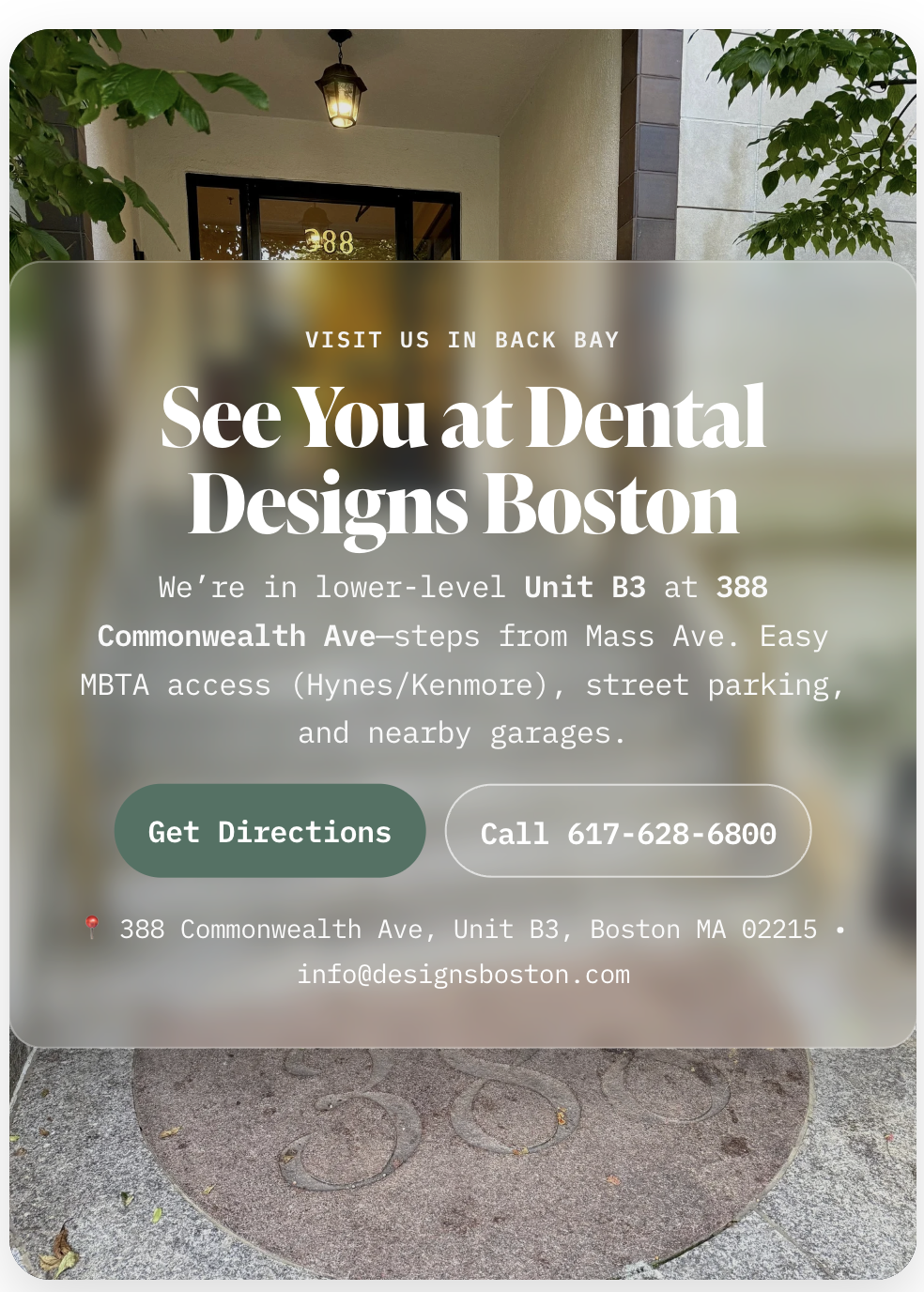
Dental Designs Boston 388 Commonwealth Ave B3 Boston, MA 02215 +16176286800 http://boston.dental/ https://maps.app.goo.gl/DPW7BYiVAEo3igAr8